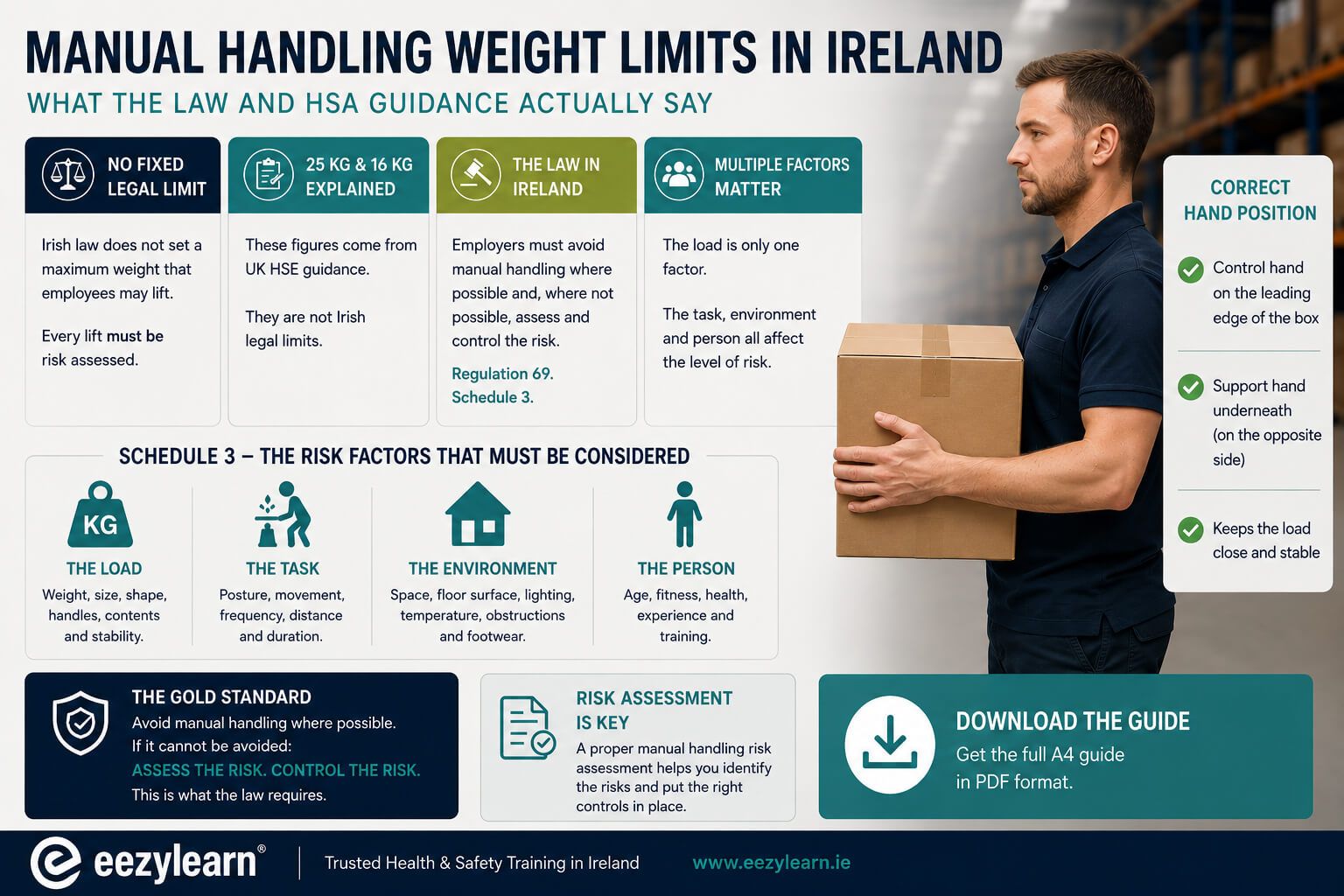
No. The often quoted 25 kg figure is not an Irish legal lifting limit.
The figure is commonly associated with guidance produced by the UK Health and Safety Executive, or HSE, rather than with a statutory Irish weight limit.
The UK HSE uses a lifting and lowering risk filter containing different values depending on the position of the load in relation to the body.
For a man, the highest value shown in that filter is 25 kg in a favourable lifting zone close to the body.
For a woman, the corresponding highest value is 16 kg.
But those figures are screening values.
The UK HSE explicitly states that its guideline figures are not safe lifting limits. Their purpose is to help identify relatively low-risk situations and determine when a more detailed assessment may be required.
The Irish Health and Safety Authority does refer employers and safety professionals to UK HSE ergonomic assessment tools, including the Manual Handling Assessment Charts, or MAC Tool. That does not turn the 25 kg or 16 kg figures into legal Irish lifting limits.
The values come from a risk-filtering system rather than from a table showing what people are legally permitted to lift.
That distinction matters.
The UK HSE filter takes account of where the load is positioned.
For example, the guideline value decreases where the load is:
close to floor level, above shoulder height, held away from the body, moved through different lifting zones or handled under less favourable conditions.
The filter also assumes relatively favourable conditions, including a load that can be gripped properly, a stable body position and reasonable working conditions.
So saying:
"Employees can safely lift up to 25 kg"
is not an accurate interpretation of the guidance.
A much more accurate statement is:
25 kg is one screening value used by the UK HSE for a particular lifting position and set of conditions. It is not a legal limit or a guarantee that a lift is safe.
Yes. Easily.
Imagine an employee lifting a 12 kg box.
On weight alone, somebody might assume that the task presents little difficulty.
Now change the task.
The box has to be lifted from floor level. It is wide and difficult to grip. The employee has to reach forward to pick it up, twist to the side and place it onto a conveyor. The task is repeated several times every minute for a substantial part of the working day.
The load still weighs only 12 kg.
But the risk profile has changed completely.
This is why Schedule 3 requires employers to consider much more than weight.
Schedule 3 groups the main considerations into five areas.
| Risk factor | Examples |
| Characteristics of the load | Heavy, large, unstable, difficult to grip, awkwardly shaped or held away from the body |
| Physical effort required | Excessive force, twisting, sudden movement or working in an unstable posture |
| Working environment | Insufficient space, uneven or slippery floors, unsuitable working height, different floor levels or unsuitable environmental conditions |
| Requirements of the activity | High repetition, prolonged effort, insufficient recovery time, excessive carrying distances or a work rate the employee cannot control |
| Individual risk factors | Physical capability, unsuitable clothing or footwear, or inadequate or inappropriate knowledge or training |
Weight, therefore, matters, but it is only one factor within a much larger assessment.
There is no provision in the Irish Regulations stating that an employee may never lift more than 25 kg.
However, that does not mean an employer can simply ask employees to lift any weight they choose.
The employer still has to comply with Regulation 69.
If the task presents a risk, the employer should first consider whether the manual handling activity can be eliminated.
Could the material be delivered closer to where it is needed?
Could the load size be reduced?
Could a pallet, trolley, hoist, lifting table, conveyor, forklift or other mechanical aid remove the need to lift it manually?
Could the workstation or storage height be changed?
Only after the task and available controls have been considered should the remaining manual handling activity be assessed.
The question shouldn't simply be:
"Can this person lift 30 kg?"
A better question is:
"Why does this 30 kg load need to be manually lifted in the first place, and can the risk be eliminated or reduced?"
That is much closer to the approach required by Regulation 69.
There is no fixed legal weight limit for a two-person lift in Ireland either.
Adding another person does not simply double the amount that can safely be lifted.
Team handling introduces additional considerations, including communication, coordination, differences in height and strength, available space, grip, visibility and whether each person can move together safely.
The Irish HSA currently identifies the UK HSE Manual Handling Assessment Charts as one of the tools that may be used when assessing manual handling risk. The MAC Tool includes a separate assessment for team handling.
For example, under the current MAC Tool, a two-person load below 35 kg falls within the green band for the load weight factor.
That does not mean that every two-person lift below 35 kg is safe.
Other factors still have to be assessed, including posture, hand distance from the lower back, vertical lifting region, grip, floor conditions, communication and the characteristics of the load.
No.
This is one of the biggest misconceptions surrounding manual handling at work.
Training can provide employees with important knowledge and practical skills, but it cannot remove a hazardous load, redesign a workstation, reduce excessive repetition or replace a mechanical lifting aid.
Interestingly, the phrase "manual handling training" does not appear in Regulation 69 or Schedule 3 of the 2007 Regulations.
Schedule 3 instead identifies a lack of adequate or appropriate knowledge or training as one of several individual risk factors.
The Health and Safety Authority itself warns against relying on training as the primary solution to manual handling risk. Its guidance states that simply providing manual handling training will not reduce injury rates or protect employees, and that the first option should be to remove or reduce the need for manual handling.
Training should therefore support effective risk controls, not substitute for them.
No.
Manual handling training isn't automatically required for every employee simply because they occasionally lift or move something at work.
The HSA specifically states that manual handling training is not mandatory for all staff.
The relevant Manual Handling Regulations concern work activities that, because of the characteristics of the load or unfavourable ergonomic conditions, involve risk, particularly of back injury.
Employers still have wider duties under the Safety, Health and Welfare at Work Act 2005 to provide appropriate information, instruction, training and supervision in relation to workplace risks and the tasks employees perform.
The appropriate training should therefore arise from the work, the risks and the control measures identified, rather than being treated as a universal box-ticking exercise.
A sensible approach is to follow the order established by the Regulations.
| Stage | Question to ask |
| Avoid | Can we remove the need for employees to manually handle the load? |
| Reduce | Can equipment, automation, smaller loads or organisational changes reduce the risk? |
| Assess | What ergonomic risk factors remain? |
| Control | What physical or organisational improvements can we introduce? |
| Inform and train | What information, instruction or task-specific training do employees need once the task has been made as safe as reasonably possible? |
| Review | Are the controls actually working in practice? |
The HSA's current ergonomic guidance similarly places risk assessment and ergonomic intervention at the centre of manual handling risk management and warns against relying on lifting technique training without other risk-reduction measures.