BLOG ARTICLE

Is Manual Handling Training a Legal Requirement for
All Employees Working in Ireland?

This blog explains the requirements for manual handling training and why it should never be the first control measure in effectively managing manual handling in the workplace.

Manual handling training is not automatically a legal requirement for every employee in Ireland.

Irish health and safety law requires employers to identify hazardous manual handling, avoid it where possible, reduce the risk where it cannot be avoided, and assess the remaining risks.

Training may be necessary as part of that process, but simply sending employees on a manual handling course does not, by itself, satisfy an employer's legal duties.

The Health and Safety Authority is very clear on this point. It states that manual handling training is not mandatory for all staff and that the first option should be to remove or reduce the need for manual handling.

The regulations governing the manual handling of loads in Ireland are "Regulations 68 and 69 of the General Application Regulations 2007". 
Regulation 68 provides the definition of manual handling, and it’s clear that this definition doesn’t apply to every lifting activity. Key considerations include whether employees are at risk due to the characteristics of the load or the ergonomic conditions involved.
Regulation 69 outlines how manual handling should be managed.
We'll talk about the regulations throughout this post. 
"The HSA also warns that providing training alone will not reduce injury rates or protect employees.
Read the HSA guidance on manual handling training!

Quick Answer: Is Manual Handling Training Mandatory in Ireland?

Does every employee legally need manual handling training in Ireland?

No. Manual handling training isn’t automatically required for every employee. The need for training should be based on the work they actually do and whether the task involves a manual handling risk, particularly a risk of injury.

Is manual handling training specifically required by Regulation 69?

No. Regulation 69 doesn’t contain a blanket requirement to provide manual handling training. It requires employers to avoid hazardous manual handling where possible, reduce the risk where it can’t be avoided, and assess the remaining risk.

Can manual handling training still be required?

Yes. Where a risk assessment shows that employees need specific knowledge, instruction or practical skills to carry out the task safely, appropriate manual handling training may form part of the control measures.

Should employers start with training?

No. The first priority should be to avoid the hazardous manual handling task where possible. If it can’t be avoided, the employer should reduce and assess the risk before deciding what information and training employees need.

What should come before manual handling training?

Risk reduction. Employers should first consider changes such as mechanical aids, smaller loads, improved storage heights, shorter carrying distances or better workstation design. Training should support these controls, not replace them.

Does a manual handling certificate make a hazardous task safe?

No. A certificate shows that training has been completed. It doesn’t prove that the task has been properly risk assessed or that the load, workstation, repetition, environment or other hazards have been adequately controlled.

Does Regulation 69 actually require manual handling training?
This is where a lot of confusion starts!
Manual handling is covered by Chapter 4 of Part 2 of the Safety, Health and Welfare at Work (General Application) Regulations 2007, particularly Regulations 68 and 69.
Regulation 68 gives us the definition of manual handling, which is "any transporting or supporting of a load by one or more employees which may include lifting, putting down, pushing, pulling, carrying or moving a load which by reason of its characteristics or of unfavourable ergonomic conditions, involves risk, particularly of back injury, to employees". 
Regulation 69 explains how we must manage manual handling to prevent and reduce the risk of workplace injuries. If you read Regulation 69, the phrase "manual handling training" does not appear.
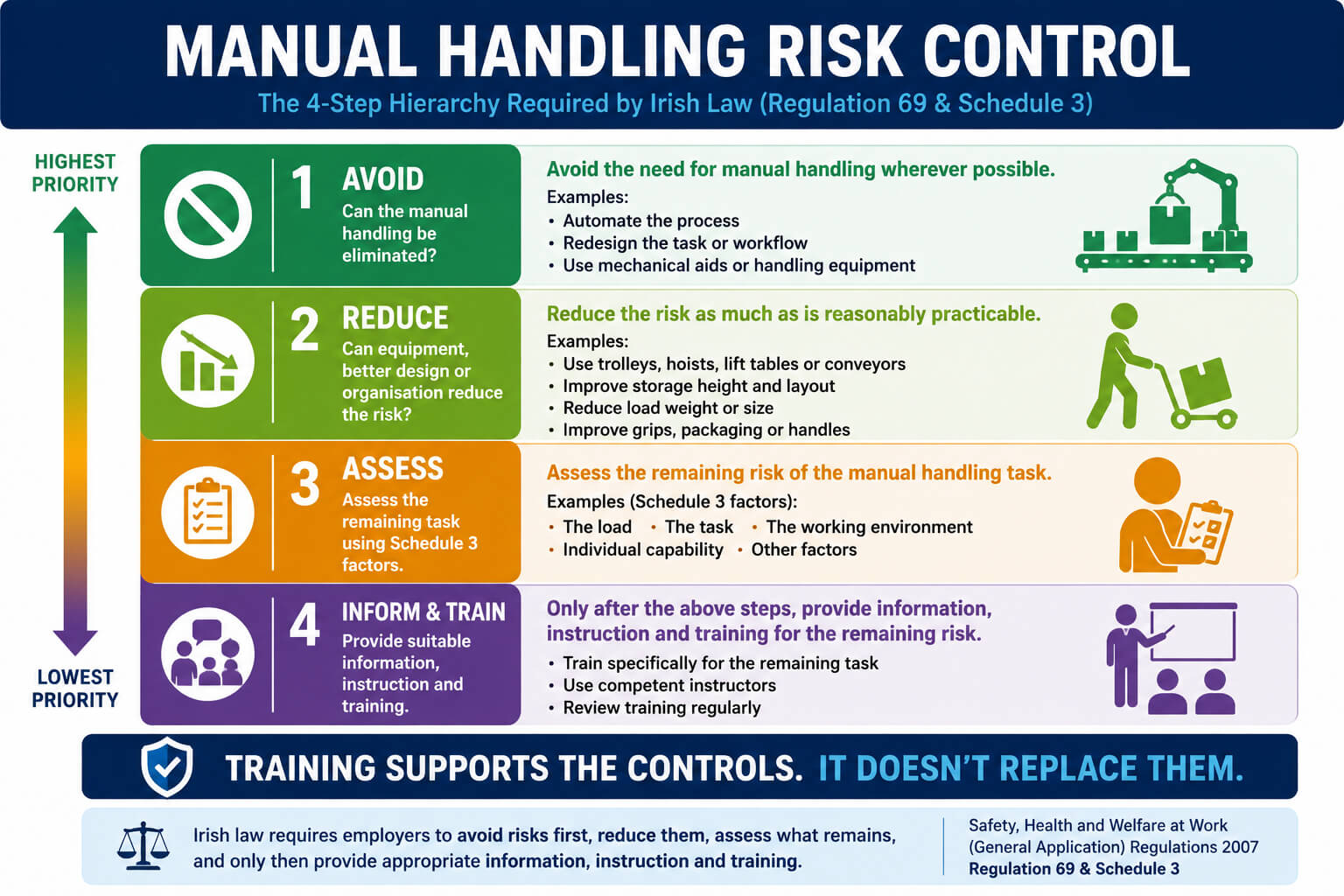
Instead, Regulation 69 requires employers to take measures to:
  1. Avoid the need for hazardous manual handling where possible
  2. Reduce the risk where manual handling cannot be avoided
  3. Assess the remaining risks
  4. Organise workstations and work so that handling is as safe and healthy as possible
  5. Take employee capabilities and individual risk factors into account
  6. Provide relevant information about loads
That order matters. (Ref: Irish Statutebooks) 
The legislation does not say:
"If an employee lifts something, send them on a manual handling course."
Click to download a free PDF version of this Poster 

So, where does the phrase Manual Handling Training appear in the law?

The actual phrase "Manual Handling Training" does not appear in the regulations. There's a process to follow before we even consider the need for manual handling training. The first step we take towards safe manual handling, as in all areas of health and safety, is with the risk assessment. 
Schedule 3 of the 2007 Regulations lists the risk factors that employers must consider when assessing manual handling. Under Individual Risk Factors, an employee may be at risk if they: 
"Do not have adequate or appropriate knowledge or training".
That is very different from saying that every employee must complete a generic manual handling course.
The question should be:
After our risk assessments have been completed and our control measures implemented, "What knowledge or training does this employee need to carry out this particular task safely"?
Not:
Has everyone got a manual handling certificate?

What should employers do before considering training?

Regulation 69 establishes a clear hierarchy.

1. Avoid the Manual Handling Task

The first question should be:
Can we eliminate the need for the employee to handle the load manually at all?
For example:
  • Can materials be delivered directly to the point of use?
  • Can a mechanical lifting aid be introduced?
  • Can a trolley, hoist, pallet truck or conveyor be used?
  • Can the process be automated?

2. Reduce the Manual Handling Risk

If the task cannot be eliminated, can the risk be reduced?
That may involve changes to:
  • load size or weight
  • lifting height
  • carrying distance
  • frequency of lifting
  • workstation layout
  • storage arrangements
  • mechanical assistance
  • staffing arrangements
  • the work process itself

3 Assess the Remaining Risk

Once the task has been improved as far as reasonably practicable, the employer should reassess the manual handling risk using the factors contained in Schedule 3.

4 Provide Appropriate Information and Training

Only then do we arrive at the question:
What information, instruction or practical training is required for the remaining task?
Training is important. But it should support the control measures already in place, not replace them.

Why do employers often start with manual handling training?

In practice, manual handling training often becomes the default response.
  • An employee reports back pain.
  • Someone sees a member of staff lifting a box.
  • A warehouse has frequent lifting activities.
The first response becomes:
"We need to get everyone manual handling trained."
That may be part of the solution, but it can distract from the more important question:
Why is the employee being exposed to the hazardous handling activity in the first place?
 If a person repeatedly lifts a heavy load from floor level because the stock is poorly stored, another demonstration of lifting technique does not fix the storage problem.
 If employees have to carry loads a long distance because a trolley is unavailable, training does not shorten the journey.
 If a workstation forces a worker to twist repeatedly, a certificate does not redesign the workstation.
This is why the HSA says the first option should be to remove or reduce the need for manual handling and that training alone will not protect workers!

Does a manual handling certificate make a task safe?

No. Absolutely not. 
A manual handling certificate shows that an employee has completed a training programme.
It does not prove that:
  • the task has been properly risk assessed
  • the load is suitable for manual handling
  • the workstation is well designed
  • the frequency of lifting is acceptable
  • mechanical aids are unnecessary
  • the employee can safely lift every load they encounter
  • the employer has complied with Regulation 69
A certificate is evidence of training. It is not evidence that the workplace risk has been adequately controlled. This is an important distinction.
"You can't train the risk out of a hazardous job. Eventually, human behaviour, complacency, tiredness, or fatigue will catch up, and the risk will still be there waiting". 

Do all employees need manual handling training?

No.
The Health and Safety Authority specifically states that manual handling training is not mandatory for all staff.
The Manual Handling Regulations apply where the work activity, because of its characteristics or unfavourable ergonomic conditions, involves a risk, particularly of back injury.
The HSA even gives the example of a worker handling light loads at waist height where there is no significant manual handling risk. In that situation, sending the worker on a manual handling course may serve little purpose.
That does not mean employers can ignore training generally.
Section 10 of the Safety, Health and Welfare at Work Act 2005 requires employers to provide employees with adequate safety, health and welfare instruction, training and supervision appropriate to their work. It also requires training to take account of the specific task and to be updated where risks or systems of work change.
The keyword is appropriate.

When is manual handling training appropriate?

Manual handling training may be appropriate where an employee is exposed to a manual handling risk that remains after avoidance and risk-reduction measures have been considered.
The training should reflect the actual work being carried out.
For example, a worker who handles:
  • barrels
  • sacks
  • awkward machinery
  • boxes in a warehouse
  • catering equipment
  • furniture
  • loads from vehicles
may require different practical information and techniques. Even then, multiple lifting aids are available to reduce the risk of injury when performing these activities. 
Generic training that bears little resemblance to the employee's actual work may have limited value.
The HSA makes the same point. It says manual handling training should be specific and relevant to the tasks involved.

Can you really train for every manual handling scenario? 

The HSA say manual handling training should be specific and relevant to the task.
In the Irish Court of Appeal case Martin v Dunnes Stores (Dundalk) from March 2016, the employee hadn’t received task-specific training for the activity that caused her injury. However, she’d been instructed not to carry out certain manual handling tasks and to ask for help when needed For other activities. She disregarded those instructions, which resulted in her injury.
Initially, the court ruled in her favour, stating that she should have received specific training for the task. Dunnes Stores appealed the decision, and the employee lost the appeal.
The case supports the principle that manual handling training should be relevant to the employee’s work and the risks involved, but it doesn’t necessarily have to replicate every possible lifting task.
It also recognises that manual handling is a transferable skill and that training an employee for every lifting activity within an organisation would be impractical, if not impossible.
Court of Appeal Guidance on Manual Handling Training

In Martin v Dunnes Stores (Dundalk) Ltd [2016] IECA 85, an employee injured her arm while lifting a 10 kg bag of potatoes from a pallet. The High Court initially found the employer liable, partly because the employee hadn’t received training specific to lifting that type of product.

The Court of Appeal overturned the decision. It found that the employee had already received appropriate manual handling training, understood how to assess a load and had been instructed to seek assistance where a task couldn’t be completed safely. The employer also had a system in place for requesting help.

Importantly, the Court held that it wouldn’t be reasonable to expect an employer to provide separate practical training for every individual product or load an employee might encounter.

The case supports the principle that manual handling training should be relevant to the employee’s work and the risks involved, but it doesn’t necessarily have to replicate every possible lifting task. Training should also form part of a wider system that includes risk assessment, safe systems of work and appropriate assistance where required.

This reflects the duties contained in the Safety, Health and Welfare at Work Act 2005 and the Safety, Health and Welfare at Work (General Application) Regulations 2007, particularly Regulation 69 on manual handling of loads. 

Who should deliver manual handling training?

Where workplace manual handling training is required, the HSA's current training framework states that it should be delivered by a QQI Level 6 Manual Handling Instructor.
The HSA also states that the training should meet the requirements set out in its Manual Handling Training System guidance.
Importantly, this does not mean that an ordinary employee manual handling course is itself a QQI-certified course.
The QQI award relates to the qualification of the manual handling instructor.
That distinction is often misunderstood.

How often does manual handling training need to be refreshed?

There is no fixed legal three-year expiry period for manual handling training.
However, the HSA recommends refresher training at intervals of no more than three years, or sooner where changes in work practices introduce a new system of work or new equipment related to manual handling.
This is another area where employers sometimes confuse guidance with a statutory expiry date.
A manual handling certificate does not suddenly become illegal or legally invalid on the third anniversary.
The real issue is whether the employee still has the appropriate knowledge and competence for the work being carried out.

The Key Point

Manual handling training has an important role in workplace safety.
But it is not the starting point.
The starting point is assessing the task.
Can the manual handling be avoided?
If not, can the risk be reduced?
Can the load, equipment, workstation or work process be changed?
What risks remain?
Only then should the employer decide what information, instruction and training employees need.
The aim should never be simply to produce a workforce with manual handling certificates.
The aim is to create a workplace where hazardous manual handling has been eliminated or reduced as far as possible, and where employees have the knowledge and practical skills needed to manage whatever risk remains.
References and Further Guidance
Irish Statute Book
Safety, Health and Welfare at Work (General Application) Regulations 2007
See particularly Regulation 69 and Schedule 3, covering the avoidance, assessment and reduction of manual handling risks.
Irish Statute Book
Safety, Health and Welfare at Work Act 2005, Section 10 
Covers employers' general duties regarding information, instruction, training and supervision.
Health and Safety Authority
Myth 4: Manual Handling Training
HSA guidance explaining that manual handling training isn't mandatory for every employee and shouldn't be relied upon as the primary means of controlling manual handling risk.
Health and Safety Authority
Manual Handling Risk Management FAQs
Guidance on assessing, avoiding and controlling manual handling risks in the workplace.
Health and Safety Authority
Manual Handling Training System FAQs
Guidance on manual handling instructors, practical training and refresher training.
About the Author
Jason Kearns, CMIOSH
Jason Kearns is a chartered occupational health and safety professional, trainer, and instructional designer with more than 30 years of experience in workplace health and safety. He develops practical workplace safety training through EezyLearn and Guardian Safety, focusing on turning health and safety requirements into clear, practical guidance for employers and employees. Jason has also been teaching manual handling instructors for over 15 years through his QQI-approved training centre, Guardian Safety.